England 0–0 Ghana: Kane’s Miss and Tuchel’s Headache in Boston
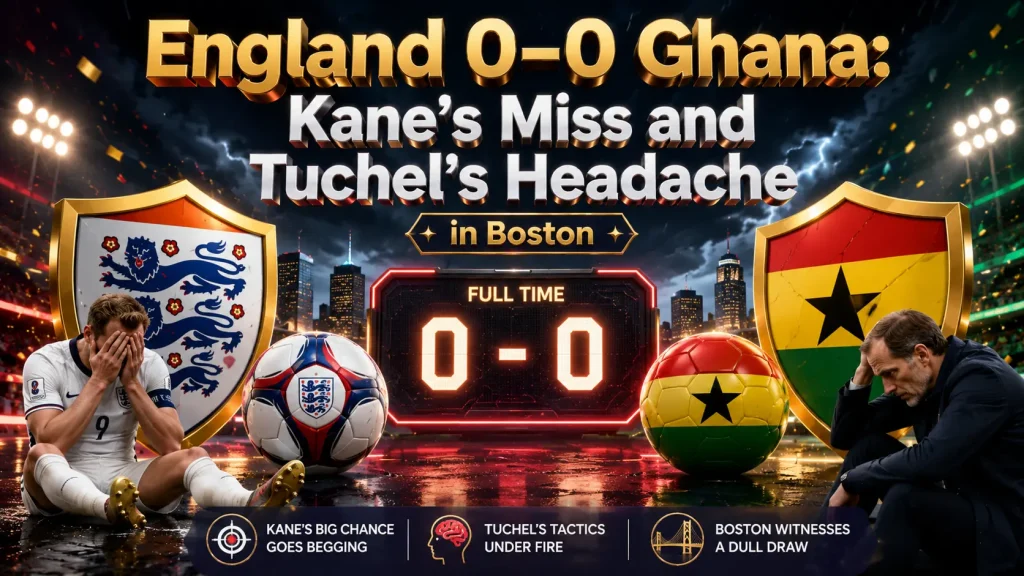
England stumbled to a forgettable 0–0 draw with Ghana at Boston Stadium on Tuesday 23 June 2026 — their second successive scoreless second game at a World Cup, and their fourth draw in the same fixture slot across the last four tournaments. Thomas Tuchel’s side dominated possession, registered 19 attempts to Ghana’s 2, and still couldn’t score. The match will be remembered for Harry Kane blazing a rebound over an open goal in the 87th minute. Ghana, meanwhile, barely crossed the halfway line — and went home having earned a point that all but books their place in the Round of 32.
Quick Facts
- Result: England 0–0 Ghana (HT: 0–0, Group L, Matchday 2, FIFA World Cup 2026)
- Stats: England 19 shots (3 on target), Ghana 2 shots (0 on target), possession 72%–28%
- Venue / attendance: Boston Stadium, Foxborough, Massachusetts
- Group L standings after Matchday 2: England 4pts (1st) | Ghana 4pts (2nd) | Croatia — (3rd, MD3 TBC) | Panama — (4th)
- England’s next fixture: vs Panama — Saturday 27 June 2026, MetLife Stadium, East Rutherford, New Jersey (10pm BST)
Why couldn’t England score against Ghana?
The short version: Ghana set up in a 4-5-1 and defended with a level of physical commitment and organisation that Tuchel himself admitted he has rarely seen. England had the ball. They just had nowhere to put it.
Ghana coach Carlos Queiroz — who met England at the 2022 World Cup with Iran and lost 6-2 — had clearly planned meticulously for this fixture. His side dropped into a compact mid-block from the first whistle, with Thomas Partey specifically tasked with following Kane and preventing him from dropping deep to link play. It worked. England completed 190 more passes than Ghana in the first 35 minutes alone, but fashioned exactly one clear first-half chance: Declan Rice nodded over from Noni Madueke’s stood-up cross in the 37th minute.
The second half was marginally better but still deeply uncomfortable viewing for anyone in an England shirt. Jude Bellingham spent the evening battling to find time and space on the ball, constantly double-marked whenever he turned towards goal. The wingers — Madueke and Anthony Gordon — stretched the pitch effectively enough, but every time either beat their man and tried to cut inside, the pass into the box didn’t find its man.
What stood out about Ghana’s performance was its intelligence rather than just its stubbornness. They didn’t just sit deep and hope — they pressed triggers smartly, won second balls, and used Abdul Fatawu’s pace in wide areas to threaten on the break whenever England lost possession. In the 78th minute, Fatawu outfought Eberechi Eze on the right flank, drove to the byline, and fed Prince Adu, who was challenged by Ezri Konsa before he could shoot. Queiroz called it a clear penalty. The referee disagreed. It remains the match’s most contentious moment.
Then came the 87th minute. Bukayo Saka’s snapshot was parried by Ghana goalkeeper Ato Asare. The ball broke to Nico O’Reilly, whose header crashed back off the crossbar. Kane gathered the rebound with the goal gaping — and sent it over the bar. “I was waiting for the ball to bounce and it did, but I couldn’t get over it,” Kane told the BBC afterwards. “It is what it is. I’ve been a striker long enough to know they don’t always go in.” In stoppage time, Marc Guéhi turned an Eze cross home only for a Ghana defender to hack it off the line in the dying seconds.
Final shots: 19–2. Final score: 0–0. That ratio is the story of the match.
What formation did Ghana use — and why did Queiroz’s plan work?
Ghana lined up in a 4-1-4-1 that functioned, in practice, as a five-man defensive line when England had the ball. Queiroz was explicit about it after the final whistle: “Our plan was to block and frustrate them from the first minute. We did it.”
The architecture of Ghana’s defensive block was intelligent. The two central midfielders — Partey and Ibrahim Sibo — sat in front of the back four, cutting off the channels between England’s lines. This left Bellingham and Rice with plenty of ball but very little forward passing options. England were forced wide, and while both wingers had the pace to get past Ghana’s full-backs, the crosses into Kane were consistently dealt with by a disciplined backline.
Partey’s role in particular deserves attention. The former Arsenal midfielder — who missed Ghana’s opening game against Panama after the Canadian government blocked his visa application — returned here and produced a performance that neutralised England’s most reliable weapon. Kane, who had seven shots in the Croatia game and was named a pre-match favourite for the Golden Boot, managed next to nothing in open play. When Kane dropped deep to link, Partey dropped with him. When Kane made runs in behind, the defensive line held its shape and the offside trap did the rest.
Ghana’s goalkeeper Ato Asare also had an excellent game on his return to the starting lineup — three saves when they were needed, and composed distribution under considerable pressure. England’s best moment, the O’Reilly crossbar in the 87th minute, was nothing to do with Asare’s positioning. The woodwork just did his job for him.
After the match, Queiroz had a pointed dig about VAR’s non-intervention on the Konsa-Adu challenge: “Once again, VAR went for a coffee. It was a clear penalty, red card. We have no doubts about that.” England will not agree. But it was the one moment in the match where Ghana genuinely threatened — and it had nothing to do with their defensive organisation and everything to do with Fatawu’s individual quality.
Is Cole Palmer’s absence from the squad the real problem?
It was the name on the lips of England fans leaving the stadium in Boston, and it is the question Tuchel will have to answer for the rest of this tournament. Cole Palmer is not in the squad. England have no one like him in the squad. And against a well-organised defensive block, the lack of a lock-picker in central positions is brutally obvious.
England completed more passes than Ghana by a ratio of roughly 7:1. They had 14 shots inside the penalty area to Ghana’s 2. And they couldn’t score. There is a specific type of quality that England are missing — not pace, not physicality, not work rate — but the ability to play between the lines, to receive the ball with their back to goal and spin, to find passes into pockets of space that don’t look like they exist until the ball is already there. Palmer, who spent last season as one of the three best attacking midfielders in the Premier League, provides exactly that. Marcus Rashford, who came on as a substitute in the 83rd minute, does not.
Tuchel pushed back on the framing. “He had one chance that he never misses and he missed it today,” he said of Kane. “He was not involved as much as we would like, but it was so narrow.” He also suggested he has ideas for how to unlock defensive blocks going forward: “I have some ideas and had an idea in the last water break, but I was a bit hesitant.” A World Cup knockout round is probably not the moment to be hesitant. Tuchel knows it. His post-match press conference was the picture of a manager who acknowledges the problem and hasn’t yet solved it.
Bellingham — named Man of the Match despite having little impact on the game — was notably candid: “Like always, second-game fever with England. Win the first one, do well, draw the second.” It was self-deprecating. It was also honest in a way that Tuchel’s official reaction wasn’t quite.
What does this mean for England’s World Cup 2026 Group L?
The good news: England are through, or very nearly. Four points from two games, with already-eliminated Panama remaining as their final group-stage opponent on 27 June. If England beat Panama — which every reasonable assessment suggests they will — they finish Group L and progress to the Round of 32.
The less comfortable news: Ghana now sit level on four points with England, and their final game is against Croatia. If Ghana beat Croatia and England beat Panama, both teams progress — but on what points, goal difference, and head-to-head record determines who finishes first. England drew 0–0 with Ghana, so on the head-to-head tiebreaker they are currently level. If both win their final matches, goal difference in group games would be the next separator.
The position England do not want to be in is finishing second in Group L. The knockout draw gets noticeably harder. Group winners get a more favourable path in the expanded Round of 32 format. England are favourites to top the group, but it is no longer the formality it looked after the 4–2 win over Croatia.
| Pos | Team | P | W | D | L | GD | Pts |
|---|---|---|---|---|---|---|---|
| 1 | England | 2 | 1 | 1 | 0 | +2 | 4 |
| 2 | Ghana | 2 | 1 | 1 | 0 | 0 | 4 |
| 3 | Croatia | 1 | 0 | 0 | 1 | -2 | 0 |
| 4 | Panama | 1 | 0 | 0 | 1 | 0 | 0 |
England vs Panama — what are the best bets for 27 June?
The match against Panama at MetLife Stadium is as close to a banker as you can find at a World Cup. Panama are already eliminated, having been beaten 1–0 by Ghana. England beat them 6–1 in the 2018 World Cup. The talent gap is significant.
Here are the markets worth considering:
- England to win and over 2.5 goals: Panama cannot defend the way Ghana did — they lack the tactical discipline and the personnel. England have the firepower to score multiple goals when given space. Around 4/7 — short odds but extremely solid for an acca leg.
- Harry Kane anytime scorer: Kane was completely nullified against Ghana. Tuchel will have worked on solutions in training. Against a team that won’t press and won’t man-mark him the way Partey did, Kane at around 4/7 to score at any time is one of the tightest value bets in the group stage. He scored against Panama in 2018 with a hat-trick.
- England to win by 3+ goals: At around 11/4, this is worth consideration given England’s goal difference ambitions heading into the knockout round and Panama’s defensive vulnerabilities. Paddy Power and bet365 will both have enhanced odds on this market.
- Jude Bellingham to score: He was peripheral against Ghana but that will change against a team that doesn’t press. Around 11/4 — decent value given his attacking output in the Croatia match.
All odds are approximate and subject to change — check current prices at William Hill, bet365, Betfred, or Paddy Power before placing.
18+ | BeGambleAware.org | Please gamble responsibly. Odds are approximate and subject to change.
Where to find the best World Cup 2026 free bets?
With the group stage coming to its conclusion and the knockout rounds approaching, the major UK bookmakers are running their strongest World Cup 2026 promotions right now. Welcome offers and enhanced odds on knockout-round bets tend to disappear once the group stage ends — so this week is the window to grab them.
Bet365 have been consistent throughout the group stage with enhanced first-goalscorer markets and in-play boosters on England matches.
Paddy Power typically run money-back specials on England games — worth checking their World Cup promotions page ahead of the Panama match.
William Hill and Betfred are both offering accumulator bonuses across World Cup matchdays — useful if you’re combining the England result with other group-stage or knockout ties.
Check our World Cup 2026 free bets page for the most up-to-date offers from all major UK-licensed operators.
New customers only. Terms, wagering requirements and minimum deposit conditions apply. 18+ | BeGambleAware.org
Final Thoughts
It wasn’t what anyone wanted. England had 72 per cent of the ball, 19 attempts, and the best striker in the tournament stood over a rebound with an open goal at his feet. The scoreline reads 0–0, and Ghana go home from Boston as deserved point-earners having executed their game plan with the kind of commitment and intelligence that most teams with their budget can only dream of achieving.
The positive is simple: England are through, or one win away from confirming it against a team that has already been eliminated. The concern is what comes after Panama. Tuchel has a squad filled with quality, a goalkeeper in Pickford who looked commanding all evening, and a captain who will score against Panama if given half a yard. But the Cole Palmer question isn’t going away. And the teams England will face from the Round of 32 onwards will have studied this performance in detail.
Ghana, for their part, can feel genuinely proud. Queiroz built something here. The same team that sat deep and lost 6–2 to this England side four years ago in Qatar came to Boston with a plan and executed it under significant pressure. The Konsa-Adu non-penalty remains a grievance, and not an entirely unreasonable one. But even with that luck factored in, England needed Kane to score a rebound from two yards. That he didn’t is the honest summary of where Tuchel’s side currently stands.
Gamble responsibly. 18+ only. Visit BeGambleAware.org for help and support.