England 4-2 Croatia: Kane Brace Puts Three Lions Top of Group L
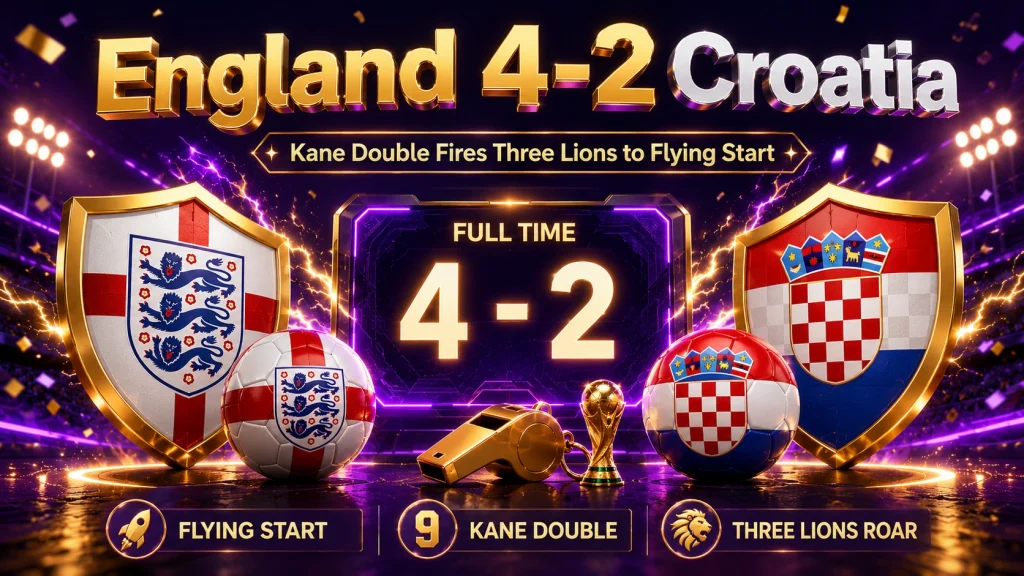
Four goals, three points, and a performance that raised as many questions as it answered. England saw off Croatia 4-2 in their World Cup 2026 Group L opener at AT&T Stadium in Dallas on 17 June — a result built on Harry Kane’s clinical double, a second half that Croatia simply could not keep up with, and a first 45 minutes that will have Thomas Tuchel watching the footage more than once before the Ghana fixture on 23 June. Kane converted a retaken penalty in the 12th minute, headed home from Declan Rice’s corner in the 42nd, and Jude Bellingham drove England ahead again two minutes into the second half. Marcus Rashford curled in the fourth on 85 minutes. Croatia, to their credit, refused to make it easy — Baturina and Musa both found the net to keep it level at 2-2 at the break.
Here is a full breakdown of what happened, what Tuchel changed, what Kane’s display actually means, and where England go from here in the world cup 2026.
Quick Facts
- Result: England 4–2 Croatia (HT: 2–2, Group L, Matchday 1, FIFA World Cup 2026)
- Goals: Kane (12′ pen, 42′), Bellingham (47′), Rashford (85′) / Baturina (36′), Musa
- Venue / attendance: AT&T Stadium, Dallas — approx. 70,000
- Group L after Matchday 1: England 3pts | Ghana 3pts | Croatia 0pts | Panama 0pts
- England’s next fixtures: vs Ghana, 23 June, Gillette Stadium, Foxborough | vs Panama, 27 June, MetLife Stadium, East Rutherford
What went wrong in the first half — and how did England fix it after the break?
The 2-2 scoreline at half-time flattered neither side. Croatia were not dominant — they were opportunistic. Their structure was tight, their transitions were fast, and every time England lost possession in the centre of the pitch, they paid for it. Baturina’s 36th-minute equaliser came from exactly that kind of turnover. Musa’s goal followed the same pattern.
England’s core problem in the first half was positional. Declan Rice pushed forward too regularly, and the space behind him opened up on both occasions Croatia scored. Bellingham was not covering that ground quickly enough. The midfield three of Rice, Bellingham and Elliot Anderson had the ball often enough — they just kept gifting it back in dangerous positions.
Tuchel made no substitutions at the break but changed the shape. England dropped into a lower, more compact block. Rice sat deeper. Bellingham was given licence to operate in the right channel, where Croatia’s defensive width was stretched. The goal came within two minutes of the restart — Bellingham driving in from midfield to make it 3-2 on 47 minutes.
The triple substitution at 71 minutes — Rashford, Bukayo Saka and Morgan Rogers all entering together — was the moment that finished Croatia off. England were leading 3-2 and Tuchel pushed for more anyway. Fourteen minutes later, Rashford curled one low into the corner. The final tally: 22 shots across the full 90 minutes, three goals in the second half alone, and nothing conceded after the break. That is a significant tactical correction under pressure.
Harry Kane World Cup 2026: has the penny finally dropped on the biggest stage?
Going into Dallas, the Kane question had been circling for years. Six goals at Russia 2018, three of them from the spot, and England knocked out by Croatia in the semi-finals. One goal across five matches in Qatar. For the all-time top scorer in England’s history, the tournament return felt thin.
What he produced against Croatia was a different kind of answer — two goals, two different techniques, both under pressure.
The first penalty tells you something about his temperament. Livakovic saved the initial spot-kick, but was judged to have stepped off his line before the ball was struck — VAR upheld the decision and Kane had to step up again. Most players lose something in that moment: the rhythm, the confidence, the crowd noise. Kane tucked it away regardless.
The second was the better goal. Rice’s corner delivery was well-weighted, Kane’s run into the six-yard box was timed to perfection, and the downward header gave Livakovic no angle. Goals 68 and 69 for England. He will be in every conversation about the Golden Boot at this tournament.
Jude Bellingham World Cup 2026: why did his 47th-minute goal change everything?
Because it removed Croatia’s only remaining strategy. At 2-2 after 45 minutes, Zlatko Dalic’s side came out for the second half planning to stay compact and strike again when England over-committed. Bellingham’s goal within two minutes of the restart made that plan redundant. Croatia now needed to attack, and they lacked the pace and width to do it effectively against England’s back line.
The finish was composed: he picked up possession on the edge of the area, took a touch inside and drove right-footed into the bottom corner. Not a thunderbolt — a controlled, deliberate finish. That composure in the decisive moments is what separates him from most players at this level.
The selection choice ahead of the game was also vindicated. Tuchel picked Bellingham at number 10 over Rogers, who came on as part of the triple substitution at 71 minutes. Rogers has quality, but Bellingham offers something different in that role: he presses high, reads Rice’s movement, and tracks runs that a more attacking player would ignore. He anchors the shape without restricting it. Rogers, at this point in the tournament, is a game-management option from the bench — and a good one.
World Cup 2026 Group L: what does this result mean for England’s route to the knockout stages?
England lead Group L on three points, level with Ghana who also won their opening fixture. The match between the two sides on 23 June in Foxborough now carries real weight — a second defeat for either team complicates their path to the last 16 considerably.
The full England world cup 2026 schedule for the group stage:
- Matchday 1: England 4-2 Croatia | 17 June | AT&T Stadium, Dallas
- Matchday 2: England vs Ghana | 23 June | Gillette Stadium, Foxborough
- Matchday 3: England vs Panama | 27 June | MetLife Stadium, East Rutherford
Croatia and Panama both sit on zero points after Matchday 1’s other fixture ended 0-0. England’s position is straightforward: two wins from two remaining games and they top the group, full stop. Even four points from six is almost certainly enough to progress.
Ghana will be a different test to Croatia. They set up deeper, press higher in transitions and are difficult to break down when organised. But England showed in the second half against Croatia that they have the attacking options to create volume — 22 shots in a single match is not a fluke. Panama, based on what they showed in the opener, look like the group’s weakest side. England should handle that fixture. The Ghana game is the real test of where this squad is.
Thomas Tuchel England World Cup: what does Dallas tell us about where this team is heading?
The clearest thing Tuchel showed in Dallas was intent. England were 3-2 up with 19 minutes remaining — a lead most managers would protect. He went for four. Three simultaneous substitutions, all attacking-minded, all designed to overload a tiring Croatia side. Rashford’s goal was the direct product of that decision. It speaks to a different kind of thinking from what England supporters were used to under Gareth Southgate.
The attacking output backs it up. Four goals from 22 shots, two from open play and two from set pieces, using players from across the squad. There is genuine depth in this England group and Tuchel is not afraid to use it.
The concern sits at the other end. Two goals conceded to Croatia — a team saying farewell to its best generation — and both came from the same structural issue: England losing shape when they turned the ball over in midfield. That is a coaching problem, not a personnel one. Tuchel has until 23 June to address it.
One more thing worth recognising: Luka Modric came off in the 57th minute, playing what was almost certainly his final World Cup match. It was his 199th international appearance. He received a standing ovation from a crowd that had been backing England all night. A player of that stature deserves that send-off. The game moves on.
Key Talking Points
Livakovic was the reason this was not 6-2. Croatia’s goalkeeper made three saves in the first half that kept his side in the match. England created enough chances to have put the game away long before half-time. He did not.
Baturina’s equaliser is the best goal of the tournament so far. Struck from distance, low and across Pickford into the far corner. He had space, but not much of it, and he took the shot on first time. That is a goal of genuine quality, not a defensive error capitalised upon.
Modric’s 199th cap deserves to be remembered beyond the result. He played for 57 minutes, was still the calmest player on the pitch, and walked off to the kind of reception most footballers never receive. That matters.
England’s defensive record is a live issue. Two goals conceded, both from the same structural weakness. Ghana, who are organised and direct, will have noted it. Tuchel’s backroom staff will spend the next six days working on it.
Verdict
A win that mattered more than it impressed. Three points, four goals, and a Kane performance that finally looked like the player England needed him to be on the biggest stage. The second half — dominant, purposeful, clinical — showed what this squad is capable of when it clicks. The first half showed the gap that still exists between potential and consistency.
The honest concern going into the Ghana match: England’s shape without the ball is not where it needs to be for knockout-round football. That is fixable. Whether Tuchel fixes it in six days is the real question.
The reason for genuine confidence: this squad has more attacking options than any England group in recent memory. Rashford and Saka both made an impact from the bench. Bellingham ran the second half. Kane scored twice. That depth will matter later in the tournament.