Germany vs Ecuador 0-0: Caicedo’s Wall Holds Firm in New Jersey
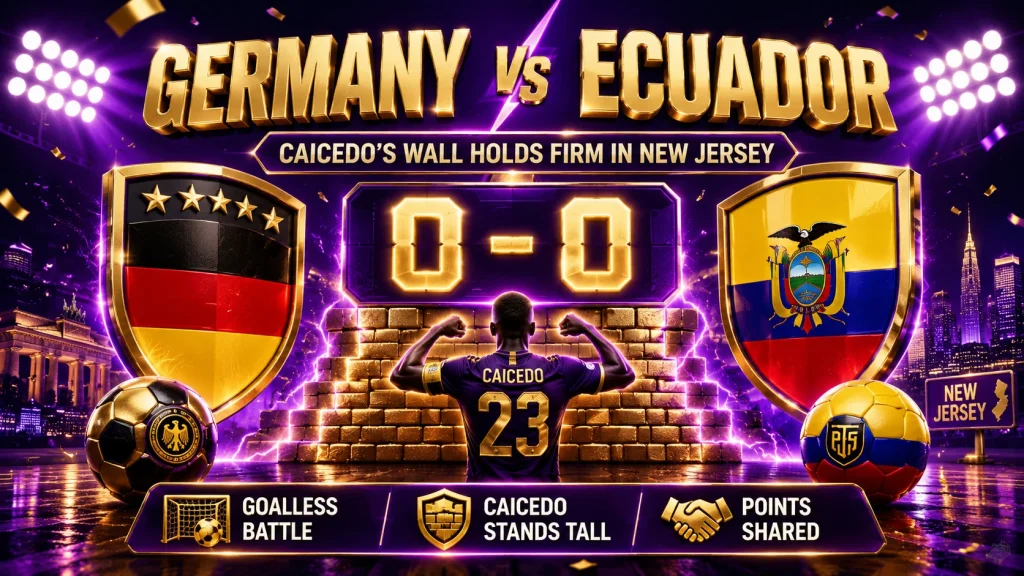
Germany drew 0-0 with Ecuador at MetLife Stadium in East Rutherford, New Jersey on 25 June 2026 — no scorers, no breakthrough, and 90 minutes of mounting German frustration in front of a sellout crowd of 82,500. Germany dominated possession, hit the woodwork twice, and forced Alexander Domínguez into six saves. Ecuador barely left their own half and still came out with a point. Germany progress to the Round of 32 as Group E winners on seven points. Ecuador are eliminated.
Here is a full breakdown of why Germany could not score, what Ecuador did tactically, and what this result means for Germany’s World Cup 2026 knockout draw.
Quick Facts
- Result: Ecuador 0–0 Germany (HT: 0–0, Group E, Matchday 3, FIFA World Cup 2026)
- Stats: Germany 22 shots (6 on target), Ecuador 3 shots (1 on target), possession 68%–32%
- Venue / attendance: MetLife Stadium, East Rutherford, New Jersey — 82,500
- World Cup 2026 Group E final standings: Germany 7pts (1st, qualified) | Ivory Coast 3pts (2nd, qualified) | Ecuador 2pts (3rd, eliminated) | Curaçao 1pt (4th, eliminated)
- Germany’s next fixture: Round of 32, 29 June 2026 — opponent: best third-placed team from Groups A/B/C/D/F (TBC)
Why couldn’t Germany score against Ecuador at World Cup 2026?
The honest answer is that Ecuador made it very, very hard — and Germany never found the key. In 90 minutes, Die Mannschaft created enough chances to win three games on paper. On the pitch, they created nothing that felt truly inevitable.
Nagelsmann set up with his trusted 4-2-3-1 and pushed Florian Wirtz and Jamal Musiala high and central, hoping their movement would stretch Ecuador’s mid-block. It did not work. Ecuador’s shape was too compact, the central channels too congested, and every time Wirtz tried to turn between the lines, either Caicedo or Alan Franco was already there. Musiala had 68 touches — the most of any player on the pitch — but only 11 in the final third. That ratio tells you everything about how little space he was given.
Kai Havertz led the line and, in fairness, worked tirelessly. But working hard and being dangerous are different things. Havertz won five aerial duels and held the ball up well, but Willian Pacho — commanding all evening — did not give him a yard. Havertz’s one genuine chance came on 61 minutes: a first-time volley from eight yards that struck the base of the left post. The MetLife crowd groaned. Ecuador’s bench celebrated.
Germany also hit the bar from a Joshua Kimmich free kick on 77 minutes. That moment — woodwork twice, six saves, 22 shots — is the clearest summary of the evening. Domínguez was excellent, yes. But Germany were also lacking the kind of incisive, between-the-lines passing that breaks down a parked defence. What surprised me was how rarely they tried the diagonal ball in behind. Ecuador’s high line on their right side was there to be attacked. Germany barely tested it.
Nagelsmann rested Leroy Sané and made three changes from the Ivory Coast win, which was understandable with qualification already secured. But the drop in attacking edge was noticeable. Germany may have had 68 per cent of the ball. They just could not do enough with it.
How did Ecuador set up tactically — and why did it work?
Ecuador coach Sebastián Beccacece knew exactly what he needed: a point and some help from the Ivory Coast vs Curaçao result. He set up to get the point first. What he got was a masterclass in defensive organisation — and not quite enough from elsewhere.
The 5-4-1 shape Ecuador used was not a panic measure. It was a plan. Beccacece had his two wide defenders push up to deny Germany’s full-backs the space to deliver crosses, while his central midfield four sat in a flat line just in front of the penalty area. The effect was a wall of eight bodies that Germany spent the entire game trying to get through.
Moisés Caicedo was the engine of it. Chelsea paid £115 million for him in 2023, and on this showing, every penny was justified. He made nine ball recoveries, completed 48 of 51 passes, and put in the defining defensive intervention of the match on 78 minutes — sliding across to block Wirtz’s shot when it looked destined for the bottom corner. When that happened, the MetLife crowd — most of them there to watch Germany — actually applauded. That tells you everything about the performance Ecuador put in.
Pacho vs Havertz was the individual duel that defined the first hour. The PSG centre-back won every aerial contest he entered and made four clearances without error. He looked like a man who had been preparing specifically for Havertz’s movement for a week — which, to be fair, he probably had.
Ecuador’s counter-threat was limited. Enner Valencia — who will almost certainly have played his last World Cup match tonight — showed willingness on a handful of breaks, but Ecuador completed only six passes in Germany’s half in the entire second period. This was containment, not football. It worked. But it also shows you the gap between what Ecuador can do and what teams like Ivory Coast can do with the same defensive base.
Worth noting the contrast with 2006. Twenty years ago, Germany beat Ecuador 3-0 in the group stage at their home World Cup. That Ecuador side was more expansive, more naïve. This one was the opposite — cynical in the best possible way, disciplined, and fully committed to the game plan. Different era, different coach, different approach entirely.
What does Germany’s 0-0 mean for their World Cup 2026 knockout draw?
Germany top Group E with seven points. They go into the Round of 32 as one of the stronger seeds. That is the good news. The concern is more subtle — but it is there.
Before kick-off in New Jersey, Germany had scored nine goals in two matches and conceded none. Nagelsmann’s side looked like a team capable of hurting anyone. After the final whistle, the question mark is back: what happens when a well-organised side parks the bus and makes Germany work through the middle? Tonight’s answer was not reassuring.
Germany’s knockout opponent will be the best third-placed finisher from Groups A, B, C, D, or F — confirmed after the final group stage matches on 26 June. Based on current standings, that could mean Paraguay, Scotland, or Bosnia. None of those sides will come out and play. All of them will sit in a shape similar to Ecuador’s.
Nagelsmann was measured after the match: “We controlled the game and created chances. A draw is not a catastrophe at this stage — we are through and we are ready.” Which is true. But I think he knows, as well as anyone watching, that the cutting edge shown against Curaçao and Ivory Coast was missing tonight. That is not a disaster. It is a data point. One that opponents in the knockouts will study carefully.
The world cup 2026 schedule means Germany have just four days before their next match. Nagelsmann will rotate again. The real test of this squad’s depth — and their ability to break down a defensive block — comes in the Round of 32.
Ecuador World Cup 2026: what went wrong and what went right?
Ecuador finish Group E with two points: a draw with Curaçao in their opener and tonight’s goalless draw with Germany. Their defeat to Ivory Coast cost them. That 1-0 loss in their second match — a goal conceded from a set piece they should have dealt with — proved fatal.
To qualify from this group with six points available, Ecuador needed to beat one of Germany or Ivory Coast. They could not do it. Against Germany tonight, they did not even really try. That is not a criticism — it is a tactical reality. Beccacece judged that attacking Germany head-on would be suicide, and he was probably right. But the consequence is that Ecuador exit having scored once in three games, with two draws and a loss.
What went right? Defensively, Ecuador were outstanding across the tournament. They conceded only twice — a penalty against Ivory Coast and a Curaçao goal in a dead rubber. Caicedo, Pacho, and goalkeeper Domínguez all deserve credit. If Ecuador had any kind of attacking threat to complement that defensive quality, this could have been a very different story.
Caicedo’s tournament stands alone. He covered more ground than any other midfielder in the group stage, won the ball back more times than anyone else in Group E, and showed why he is consistently one of the top five midfielders in the Premier League. He will leave New Jersey with his reputation enhanced, even if Ecuador do not.
Ecuador’s best ever World Cup finish remains the Round of 16 in 2006 — the same tournament where Germany beat them 3-0. They did not surpass it here. But this squad showed enough to suggest the next cycle could bring something better.
Nagelsmann World Cup 2026: right call to rotate — or a missed opportunity?
Nagelsmann made three changes from the Ivory Coast win. Sané dropped to the bench, replaced by Thomas Müller — who, at 36, showed glimpses of his old sharpness but lacks the legs to press continuously for 90 minutes. Serge Gnabry started on the left ahead of the fit-again Karim Adeyemi. At right-back, Benjamin Henrichs came in, freeing Kimmich to play deeper in midfield.
Was it the right call? Broadly, yes. Germany were already through. Resting Sané, who had played every minute of the tournament so far, makes sense ahead of a knockout tie. The same logic applies to the other rotation decisions.
But here is the issue. Germany’s depth in forward areas is not as strong as the first-choice lineup suggests. Müller is a brilliant footballer with three months left at the top level. Gnabry has been inconsistent. When the first-choice press is not firing, Germany look noticeably less threatening — and tonight was proof of that.
What this match told us about Germany’s squad depth is not entirely comfortable. The starting eleven against Curaçao — seven goals, complete control — looked like a team capable of winning the tournament. Tonight’s eleven, against a well-organised but limited Ecuador, looked like a team that might struggle if they meet Spain, France, or Brazil in the quarterfinals.
The positive comparison is this: Germany beat Ivory Coast 2-1 with character and composure. They showed they can win ugly as well as beautifully. Tonight is a blip, not a pattern. But the blip needs addressing before the knockouts begin.
Key Talking Points
Domínguez was the best goalkeeper performance of the tournament so far. Six saves, two crucial stops in the second half, complete command of his area. There is a genuine case that he was the best goalkeeper on the pitch at any World Cup 2026 game to date.
Caicedo vs Germany’s midfield: Chelsea’s investment justified. Nine ball recoveries. Forty-eight accurate passes. The block on Wirtz in the 78th minute. Caicedo was everything Chelsea fans hoped he would be when they spent £115 million. The world cup 2026 results will show a 0-0. His display deserved more.
Germany hit the woodwork twice. Havertz struck the post on 61 minutes. Kimmich’s free kick rattled the crossbar on 77. In another game — or with a different goalkeeper — those are two goals. They were not tonight.
Ecuador go out with their heads held high. They were the only side in Group E not to lose to Germany. They ran Ivory Coast close. And they showed a level of defensive organisation that teams two or three places above them in the FIFA rankings could learn from. There is no shame in this elimination.
Verdict
Germany are through and they are dangerous. But this 0-0 exposed something that the wins over Curaçao and Ivory Coast had papered over: when space is removed and the block is set, Nagelsmann’s side can look one-dimensional. That is a concern worth monitoring. Ecuador, meanwhile, exit having done almost everything right except score goals. Beccacece built something defensively coherent in a very short time. Caicedo was the best player on the pitch. And Domínguez had the game of his life at exactly the right moment — just not quite at the right time to change Ecuador’s World Cup fate.
Danny’s verdict: Germany will win the tournament if Wirtz and Musiala find their rhythm in the knockouts. If they do not, they will go out to the first side that defends like Ecuador did tonight.